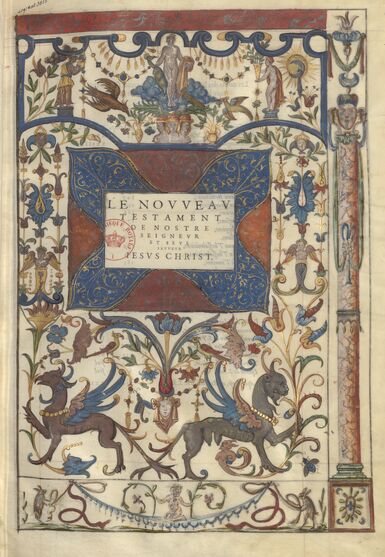
La Sainte Bible: Le Novveav testament de nostre seignveur Iesvs Christ.
by Melvin

| Title | La Sainte Bible:Le Novveav testament de nostre seignveur Iesvs Christ. |
| Editor | Jean de Tournes |
| Contributor | Salomon Bernard |
| Date | 1557 |
| Place | Lyon, France |
| Language | French |
| Source | gallica.bnf.fr / BnF |
Introduction
The Bible, as an object of devotion and cultural transmission, has often combined text and image to enhance its spiritual and pedagogical impact. The 16th-century Lyon edition of the Bible, produced by Jean de Tournes and enriched with engravings by Salomon Bernard, is a fascinating example of this interplay between sacred text and illustration. By focusing on Chapter XVI of the Book of Revelation, where the seven bowls of God’s wrath are poured out upon the earth, we will explore how imagery amplifies the message of the text in the context of the Reformation and cultural transformations of the time.
Context
Chapter XVI of the Book of Revelation depicts the seven bowls of God’s wrath, a pivotal moment in the apocalyptic prophecy. These bowls, carried by seven angels, symbolize divine judgments upon sinful humanity and a corrupted world. Each bowl unleashes a catastrophe: sores, contaminated seas and waters, darkness, earthquakes, and plagues. The chapter culminates in the destruction of Babylon, a symbol of opposition to God. Rich in symbolic and terrifying imagery, this text has often inspired artists seeking to translate its powerful prophetic visions.
Printing in Lyon
In the 16th century, Lyon was a major center of European printing. The city benefited from its strategic location on trade routes and its dynamic intellectual environment fostered by Renaissance humanism. Lyonnais printers, such as Sébastien Gryphe and Jean de Tournes, played a key role in disseminating religious, literary, and scientific texts. This century witnessed the rise of illustrated books, with woodcuts and copperplate engravings making books more appealing and accessible to both learned and popular audiences.
For a global view of printing in lyon, watch this video from the ENS of Lyon:
The editor
Jean de Tournes, a printer and bookseller from Lyon, was a prominent figure of Lyonnais humanism. With the typographic tradition founded by Aldus Manutius in Venice, he combined editorial rigor with aesthetic sensibility. In 1547, he was appointed printer to King Henry II, a proof of the quality of his work. Jean de Tournes is especially renowned for publishing biblical and classical texts, often enriched with illustrations. His works reflect the growing influence of Reformation ideas in Lyon and an interest in visual representations that are both refined and evocative.
The Engraver
Salomon Bernard was an engraver and draftsman active in 16th-century in Lyon. A regular collaborator of Jean de Tournes, he was renowned for his highly detailed woodcuts. His works, often created to illustrate religious or literary texts, stand out for their narrative richness and attention to detail. In his Bible illustrations, Bernard conveys the dramatic power of biblical scenes while respecting the spirit of the text. His style, influenced by Italian and Flemish masters, exemplifies the fusion of art and printing in the service of the sacred.
The illustration
As with the illustration of Chapter XVI, each illustration in this edition reflects the quality of work provided by the publisher and the illustrator, whether through the colors, the details, or the fidelity to the described passages. Here, we can observe numerous references to the associated text: the presence of the seven angels bringing their calamities, such as the one turning water into blood with the depiction of the well, the sun scorching men, or the earthquake destroying the city of Babylon.
Test your knwoledge with this Twyne story
Sources
- Jean de Tournes: Biblissima, BNF Data
- Bernard Salomon: Nubis, BBF
- Printing in Lyon: Gadagne Museum, ENS of Lyon